Source & credits: This article is based on the following sources:
- Original project: Bush Cradle, Good Design Awards 2026 (Next Gen)
- Designer: Xavier Earls, designed in Australia
- Commissioned by: Xavier Earls and Monash University
- Video interview: Monash University on YouTube. Quotes and details on habitat loss, nest boxes, materials and possum testing are from Xavier Earls in this video.
The climate and hemp wood products section is HBD’s own commentary and is not part of the Bush Cradle project.
A Monash student’s four-part hempcrete kit shows hemp for habitat can work in the bush, not just on the building site
Most of us think of hemp building as walls, insulation and floors for people. The Bush Cradle flips that, using hempcrete to shelter the animals that are losing their homes.
“Physical things can influence the environment.” — Xavier Earls, designer of the Bush Cradle
The problem: habitat that can’t regrow fast enough
Habitat loss is one of the major threats to native animals in Australia. Natural shelter like tree hollows and fallen logs can’t be replenished at a rate that keeps up, according to Earls. He points to Australia’s extinction rate for terrestrial mammals, which he describes as one of the highest in the world.
The usual stopgap is the plywood nest box. Earls says these can’t be tailored to particular species at scale, and high temperatures can cook animals inside them. In his words, they’re a one-size-fits-all solution, and if one doesn’t suit a species it can’t be modified.
What is the Bush Cradle?
Bush Cradle was designed by Xavier Earls, who was studying a Bachelor of Industrial Design at Monash University, and commissioned by Earls and Monash. It is listed under Next Gen 2026 at the Good Design Awards.
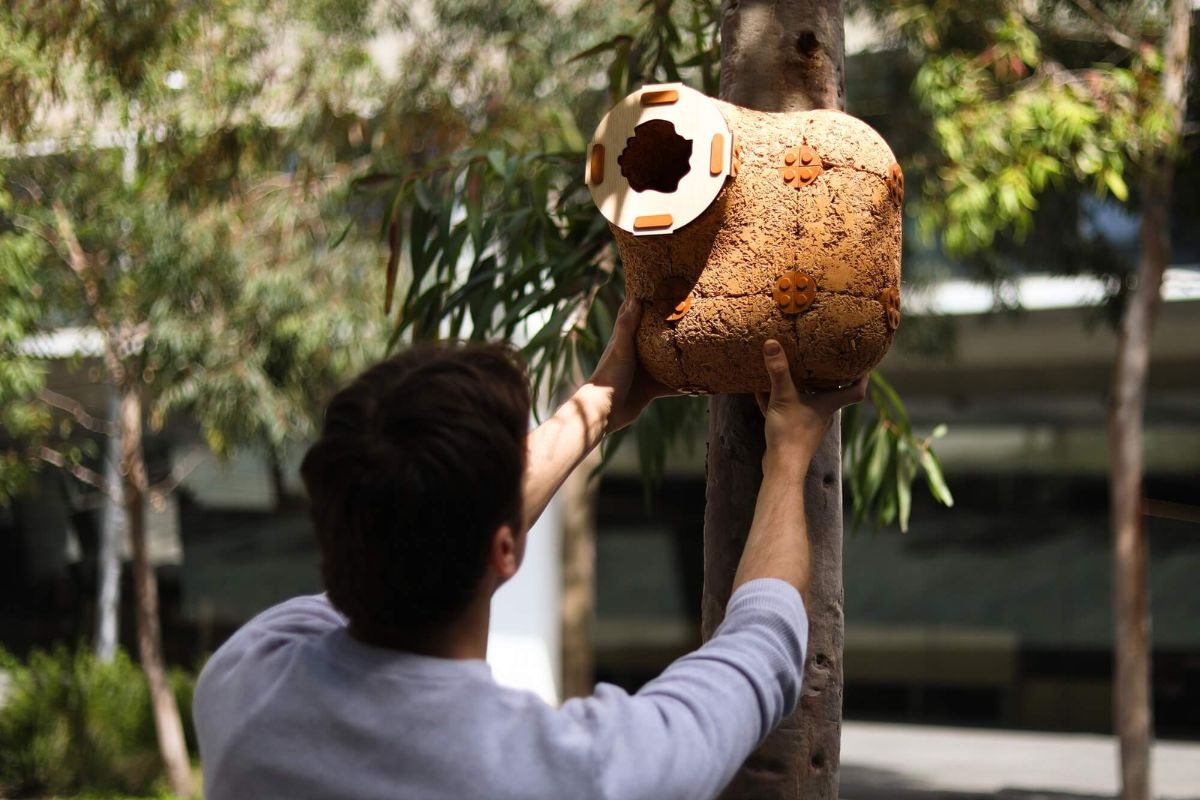
It’s a habitat system that gives conservationists the pieces to build tailored refuge for vulnerable native animals. The kit works like Lego:
- Four parts of simple geometry
- Slots key into cavities in each part, held in place with pins
- Hand tools only, so a habitat can be as simple or complex as needed
- Fully reversible: it can be pulled apart and rebuilt in a new arrangement
- Flexible siting: on the ground or up in a tree, depending on the species
Why hempcrete?
Earls wanted materials that were as biomimetic as possible, so he turned to organic, fibrous, biodegradable materials. Hempcrete forms the insulating layer of the structure. That matters for hemp for habitat work, because insulation is what protects animals from the temperature extremes that make plywood boxes risky.
Hempcrete is a bio-composite of hemp hurd and a mineral binder. It’s a natural, low-toxicity material made from a renewable crop, and it moulds into modular pieces.
Tested by possums
Earls prototyped with 3D printing, then moved to an involved casting process, packing combined materials into the models. For proof of concept, he wanted to see animals enter and exit comfortably. He installed a unit in a tree with a trail camera and recorded ringtail possums sniffing around, investigating, crawling inside and leaving again.
Hemp as a tool against climate change
Habitat loss and climate change are tangled together, and hemp has a role in both. Hemp grows fast, drawing carbon dioxide from the air into its fibre and hurd. When that biomass goes into long-lived building products, the carbon stays locked up instead of returning to the atmosphere.
That’s why the growth of hemp wood products matters. Hemp boards, panels and engineered fibre materials can substitute for products made from slow-growing timber or energy-intensive materials. A crop that matures in a season rather than decades takes pressure off native forests, and every forest left standing is both habitat and a carbon store.
As the industry develops more hemp wood products, each one becomes a small climate tool: carbon stored in the building, less demand on forests, and a crop that can fit into regional farming rotations. The Bush Cradle shows the same material doing double duty, built from a carbon-storing crop and used to protect the wildlife that climate change threatens.
What this means for hemp builders
Earls says industrial design skills usually serve the commercial market but can be applied to environmental problems. The same goes for hemp building. Habitat restoration, conservation infrastructure and landscape projects are new markets for the builders, makers and growers in the Hemp Building Directory.
FAQ
Can hemp be used to build animal habitat?
Yes. The Bush Cradle uses hempcrete in a four-part kit that can be arranged into different forms to create refuge for vulnerable Australian native animals.
Why not just use plywood nest boxes?
According to designer Xavier Earls, plywood boxes can’t be tailored to specific species at scale, can’t be modified if they don’t work, and high temperatures can cook animals inside them.
What is hempcrete made from?
Hempcrete is made from hemp hurd (the woody inner core of the plant) mixed with a mineral binder, usually lime-based.
Is hemp good for the environment?
Hemp grows quickly, absorbs carbon dioxide as it grows, and stores that carbon when used in long-lasting products like hempcrete and hemp boards. It can also reduce demand for products that rely on forest timber.
Sources:
Link ideas: HBD hempcrete directory listings, AgriFutures Australia hemp page.
Disclaimer
HBD do not warrant the quality or experience of anyone listed on this directory.
We have relied on the information provided by the business and its representatives.
This site is not intended to provide and does not constitute building advice, or other professional advice.
This is an ad by Google