What the Senate enquiry recommendations for hemp construction mean for builders, insurers and the National Construction Code
For anyone who has spent years building with hemp, testing hempcrete, or trying to explain to an insurer why a proven, fire-resistant, carbon-storing wall system still isn’t in the code books, this is a genuinely exciting moment. The Senate Rural and Regional Affairs and Transport References Committee’s report, Opportunities for the development of a hemp industry in Australia, doesn’t just acknowledge the potential of hemp construction, it puts forward clear, actionable recommendations to fix the regulatory gaps that have held the sector back. It’s a strong signal that the work of builders, growers, and advocates across the country is being heard at the highest level.
The Senate enquiry recommendations for hemp construction
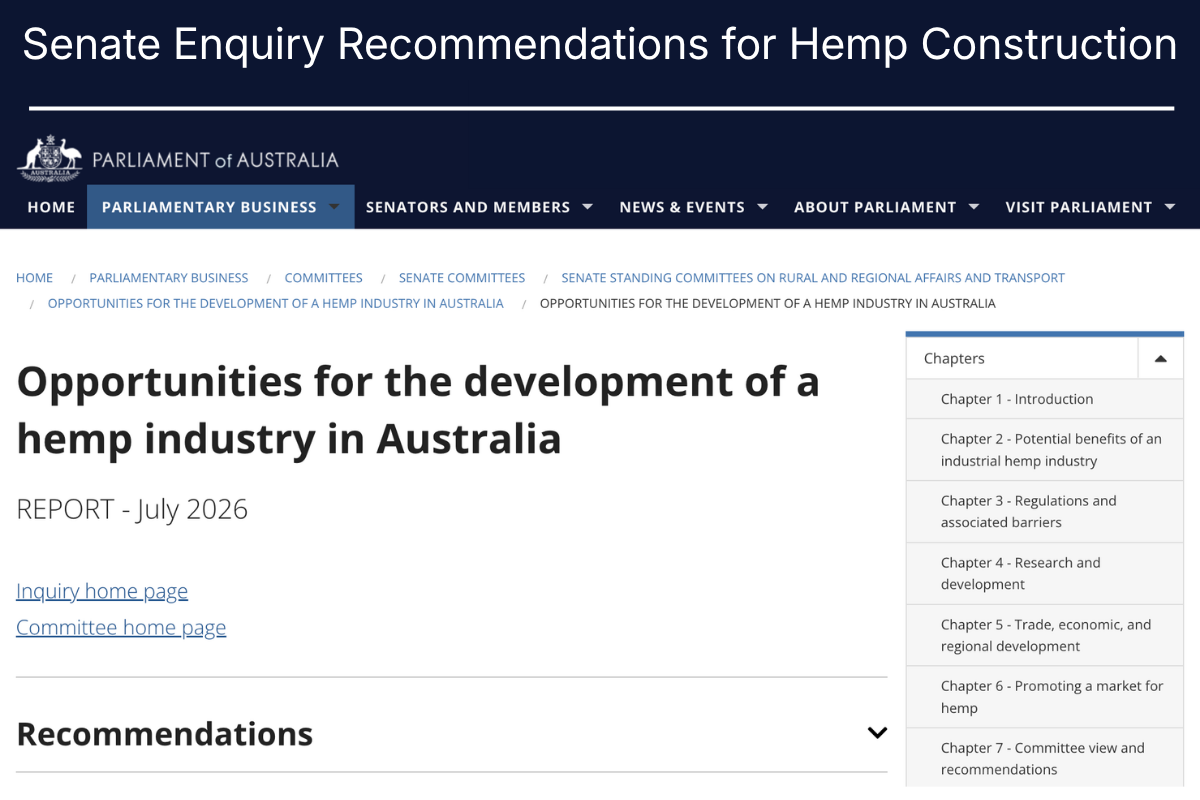
Of the fourteen recommendations in the report, four go directly to building and construction:
- Recommendation 9 — The Australian Building Codes Board develops a standard under the Building Code of Australia supporting the use of hemp-based products in construction.
- Recommendation 10 — The Australian Government supports formal testing to establish fire ratings for hemp-based construction products.
- Recommendation 11 — The Australian Government conducts formal measurement of the carbon carrying capacity of hemp-based construction products.
- Recommendation 12 — The Australian Government establishes a taskforce to develop a best-practice standardisation process for hemp building materials and recognise hempcrete in the National Construction Code (NCC).
Together, these recommendations tackle the two biggest barriers stakeholders raised throughout the inquiry: the absence of hempcrete from the NCC, and the lack of standardised fire and carbon data to support it.
Why the National Construction Code matters so much
The committee heard repeatedly that the lack of formal recognition of hempcrete in the NCC is the single biggest constraint on the industry. Without a national standard, every hemp building project is assessed individually, and that case-by-case process creates cost, delay, and uncertainty that discourages builders, certifiers and insurers alike.
The Hemp Building Directory’s own submission was cited directly in the report:
“Hempcrete and other hemp-based building materials are underutilised in Australia due to limited awareness, insufficient training, fragmented supply chains, and regulatory uncertainty.”
The submission also pointed out that while the NCC technically allows hempcrete to be approved via performance solutions, the cost and complexity of that process shuts smaller operators out entirely.
TasFarmers made a similar point, telling the committee that the lack of standard classifications creates inconsistency in product quality and deters uptake, and that formal inclusion in the NCC “would enable hemp to flourish as a sustainable building practice.”
The insurance problem
Several submitters raised a knock-on effect of the code gap: insurance. As iHemp NSW President Jaimie Milling explained, French-made hemp hurd products imported into Australia can be insured because they’re certified, but Australian-made, uncertified hempcrete often can’t be. As the report puts it plainly: “Where there is no certification of materials, there is no insurance cover.”
Colin Steddy of iHemp NSW summed up the frustration of having to reinvent standards that already exist overseas:
“In the US they have got hemp building standards. In Australia, they won’t accept the hemp building standards that America have all done. We’ve got to start from scratch and do it again… it costs hundreds of thousands of dollars.”
A track record that speaks for itself
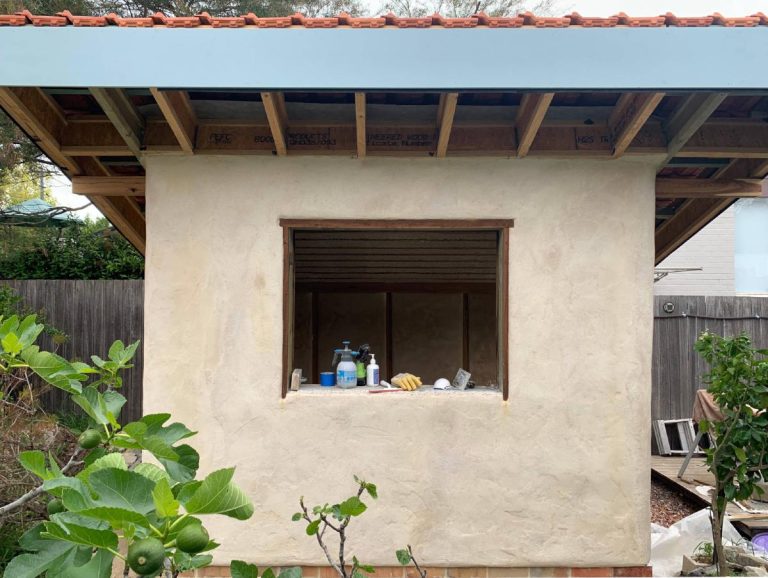
The regulatory gap isn’t for lack of proof. The Australian Hemp Masonry Company told the committee it has supplied materials to over 250 residential projects, plus landmark builds including the University of Tasmania Forestry Building in Hobart and Powerhouse Place in Mildura, every one of them requiring its own individual performance assessment because there’s no overarching standard to fall back on.
Australia doesn’t need to start from zero
A recurring theme in the committee’s findings is that Australia can lean on international precedent rather than reinventing it. Hempcrete was added to the 2024 International Residential Code in the United States, and fire-resistance standards are actively being developed overseas. The Housing Industry Association told the committee that international recognition should be a “signal” that hemp standards can be adapted here, cautioning that governments are “often too eager to make new rules which can constrain markets or the growth of new products.”
As the committee itself concluded: “The regulatory wheel does not need to be re-invented here. Australia should align with this movement towards more readily allowing hemp-based building and construction materials.”
Housing material supply. There are a number of companies working on this issue with a variety of housing material formulations being developed. The industry is very close to producing an ideal product, and there are a number of cabin/housing prototypes being built already.
With a major housing shortage across Australia and curtailing of the forestry industry, emergence of the carbon sequestration requirements, I believe the hemp industry is well placed to fill this emerging need.
Tim Schmidt is a Tasmanian farmer | Hemp Today interview July 27, 2026
What happens next
The report recommends that supporting research, carbon carrying capacity measurement and formal fire ratings, be conducted first, potentially as part of a next-stage R&D program, to give the Australian Building Codes Board the evidence base it needs to act. It’s a sequenced, practical pathway: test it, measure it, standardise it, and get it into the code.
Matthew Lariba-Taing, President – Australian Hemp Council
The AHC has also commissioned HempToday to undertake an analysis of the Senate Inquiry Report to identify key opportunities for the industry and more specifically to highlight investor opportunities. The document – ‘Building Australia’s Hemp Economy – Investor’s Guide to the Senate inquiry‘ can be downloaded here.
FAQ
Does the National Construction Code currently allow hempcrete? Yes, but only through individual performance-based assessments rather than a recognised standard, which adds significant cost and complexity to every project.
What are the Senate enquiry’s building-specific recommendations? Four recommendations (9–12) call for a Building Code of Australia standard, formal fire rating testing, carbon carrying capacity measurement, and a taskforce to standardise hemp building materials and recognise hempcrete in the NCC.
Why is hempcrete hard to insure in Australia? Insurers are reluctant to underwrite hemp buildings because there’s no national certification standard — certified imported products can be insured, while uncertified local ones often can’t.
Has hempcrete been used in major Australian buildings already? Yes. Examples cited in the report include the University of Tasmania Forestry Building in Hobart and Powerhouse Place in Mildura, alongside more than 250 residential projects.
Are other countries ahead of Australia on hemp building standards? Yes. The United States added hempcrete to its International Residential Code in 2024, and the committee recommends Australia align with this international momentum rather than starting from scratch.
This is an ad by Google
Disclaimer
HBD do not warrant the quality or experience of anyone listed on this directory.
We have relied on the information provided by the business and its representatives.
This site is not intended to provide and does not constitute building advice, or other professional advice.
This is an ad by Google