Prepared by Jeremy Thomas, proofed by Phil Warner May 2026
The basic carbon story
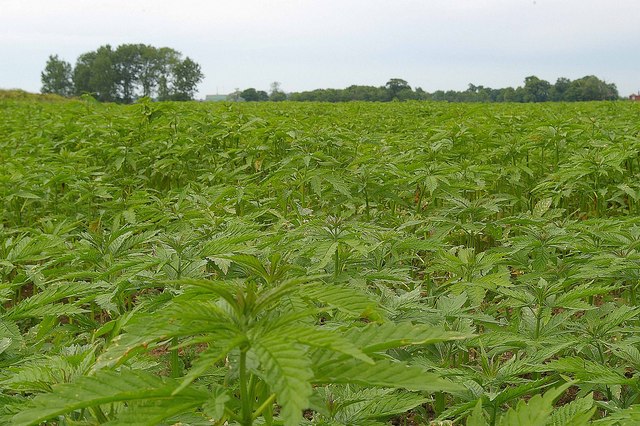
Hemp is one of the fastest carbon-sequestering plants on earth, reaching full height in around 100 days. What makes it uniquely interesting for carbon accounting isn’t just how fast it grows, it’s what happens to the carbon after harvest.
When hemp hurd (the woody core of the stalk) is mixed with lime binder to make hempcrete, the carbon locked into that plant material doesn’t go back into the atmosphere. It goes into a wall. That wall goes into a building. The building stands for 50, 100, or 200 years. The carbon stays.
This is the critical distinction between hemp-for-hempcrete and every other annual crop. Standard carbon credit frameworks exclude annual crops on the basis that carbon cycles back to the atmosphere quickly. The crop grows, sequesters carbon, dies or decomposes, and releases it again. Hempcrete breaks that logic entirely. The carbon is locked into a lime-stabilised matrix inside built infrastructure. It is, for all practical purposes, permanent.
The numbers: a 10m2 wall
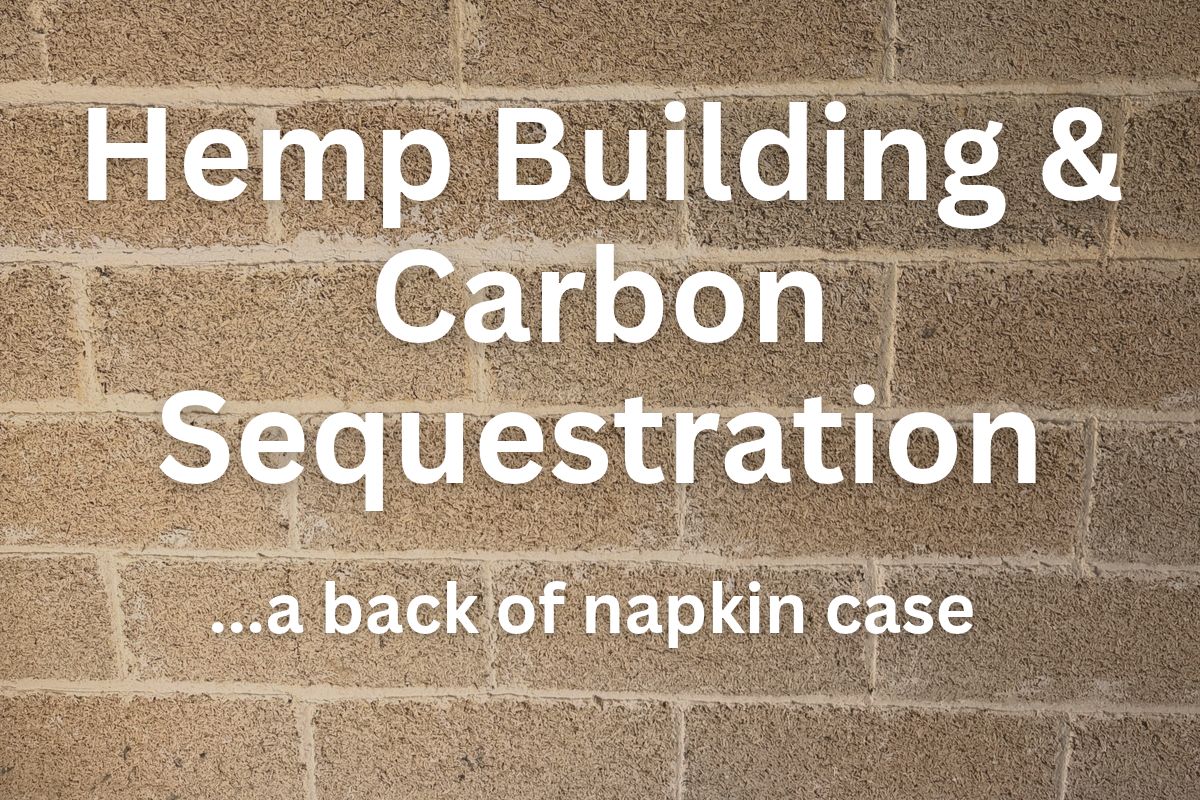
Take a simple hemp wall: 10m2 of face area, 250mm thick. That’s 2.5 cubic metres of hempcrete, weighing roughly 875kg at a typical density of 350kg per cubic metre.
Hemp hurd makes up around 60% of hempcrete by weight, so approximately 525kg of hurd per 10m2. Lab analysis of Australian hemp hurd (Ecofibre Industries, Southern Cross University, 2004) shows carbon content sitting at around 50% of dry weight. That gives us roughly 262kg of carbon stored per 10m2 wall, or approximately one tonne of CO₂ equivalent.
A modest home with 80 to 120 square metres of external hempcrete wall therefore sequesters somewhere between 8 and 12 tonnes of CO₂, locked in for the life of the building. And even more as it carbonates over the 100+ years lifetime of the building.
At current voluntary carbon market prices of $20 to $50 per tonne, that represents $160 to $600 per house in carbon credit value. Modest on its own. But across a pilot program of ten homes, that’s $1,600 to $6,000, and more importantly, a verified, measurable, replicable methodology.
The roots: an overlooked sink
Above-ground sequestration is only part of the story. Hemp has a substantial root system, deep taproots reaching 1 to 2 metres, and root biomass typically represents 20 to 30% of above-ground plant mass. For a hemp crop yielding 10 to 15 tonnes per hectare above ground, that’s 1 to 3 tonnes of root biomass remaining in the soil at harvest, at roughly 45% carbon content.
That translates to approximately 3.5 to 6.5 tonnes of CO₂ equivalent per hectare sequestered in the soil, permanently improving soil structure and microbial health in the process. This makes hemp an excellent rotational crop alongside cotton and other broadacre farming, actively building soil carbon between cycles.
This root sequestration has a practical implication for transport accounting. Trucking hemp hurd from Queensland to Victoria (roughly 1,800 kilometres) costs around 216kg of CO₂ at standard freight emission factors. Root carbon alone offsets that transport cost many times over per hectare grown. The full lifecycle carbon position of Australian-grown hemp for hempcrete, even accounting for transport, remains strongly positive.
The policy gap
Despite this clear case, hemp-for-hempcrete currently sits outside established carbon credit methodologies in Australia. The annual crop exclusion, designed to prevent credits being issued for carbon that cycles back quickly, has not been updated to account for materials that enter long-lived built infrastructure.
Closing this methodology gap is the work. It requires scientific verification of sequestration rates, a credible permanence argument based on building lifespan, and a measurement framework that can be applied consistently at point of construction. Several Australian organisations are beginning this work. The opportunity is to develop an Australian-first methodology that could underpin a new class of carbon credit and a new value stream for the hemp building industry.
Why right now
The regulatory environment is arriving faster than most of the building industry realises, and hempcrete is not yet positioned to take advantage of it.
The NCC 2025, published February 2026, introduces a voluntary embodied carbon pathway for commercial buildings, with states able to adopt from May 2026. The expectation across the industry is that mandatory embodied carbon standards follow in the NCC 2028 update, giving the sector roughly two years to build methodology and measurement capability before compliance becomes compulsory.
Green Star Buildings v1.1, with registration required from 1 May 2026, already mandates that all rated buildings address upfront carbon, a minimum 10% reduction against a reference building for base certification, rising to 20% for higher ratings, with a stated 40% reduction target by 2030. For any developer pursuing Green Star, the embodied carbon of their wall systems is now a procurement decision, not an afterthought.
At the corporate level, mandatory Scope 3 emissions reporting begins for large companies (those with revenue over $200 million) for financial years starting July 2026, with mid-sized companies captured from July 2027. Scope 3 captures the full embodied carbon of materials across the supply chain. For construction companies and developers, that means the carbon footprint of every product they specify will need to be known and reported.
The problem is that an estimated 94% of the approximately 500,000 construction products available in Australia have no verified carbon footprint claim. Hempcrete and hemp building materials are almost entirely absent from verified product databases, despite being among the most carbon-positive building materials available.
This is the gap. The science is clear, the regulatory demand is arriving, and the verified data does not yet exist. The organisation that builds that data infrastructure for the hemp building industry will define how it participates in the low-carbon construction economy for the next decade.
The platform
Hemp Building Directory (hempbuilding.au) aims to be the connective tissue of the hemp building industry in Australia and New Zealand: builders, suppliers, architects, educators and advocates. It is a natural stakeholder for a pilot program of this kind, providing the industry relationships, credibility and reach that any carbon methodology initiative would need to succeed.
Article by Jeremy Thomas
Thanks to Phil Warner for proofing and small contributions.
Disclaimer
HBD do not warrant the quality or experience of anyone listed on this directory.
We have relied on the information provided by the business and its representatives.
This site is not intended to provide and does not constitute building advice, or other professional advice.
This is an ad by Google